Showing posts with label imagery. Show all posts
Showing posts with label imagery. Show all posts
Wednesday, April 6, 2011
Splish Splash I Was Taking A Bath
pg. 184 "The birds sing just as sweet when us leave as when us come. Then, look like as soon as us turn back on the main road, they stop. By the time us got to the cemetery, the sky gray." Here, imagery depicts the tone of the scene. I found this chapter completely ironic because these beautiful flowers and trees line the drive up to the house, a place of gloomy memories from Celie's past. Yet when she drives up with Shug, knowing she will see Pa, the beauty consumes her. For such an ugly cruel man, Pa knew how to keep a pretty, lively looking house. We don't see anything else about birds singing (giving a positive connotation), so automatically there seems to be some tension as she arrives at and leaves the house. As soon as she enters the real world past the house of her childhood, the world turns gray and gloomy again. Celie so yearns for color in her gray world! Luckily, she finds that inevitably in the pants she makes and connection upheld with Nettie.

Sunday, October 31, 2010
Isolated Emily
William Faulkner's "A Rose for Emily" encapsulates the general isolation of a lonely woman in a Southern, nosey town. From the plural first person point of view, the narrator includes himself with the townspeople, thus serving as the first indication of the distance and isolation between Miss Emily and the townspeople of Jefferson. The townspeople gather on occasion to discuss issues regarding Miss Emily's estate: the tax affair and the smell of the house. As a general concensus, the "we" indicate "they" must do something about "her." She is isolated from their decisions. I found it especially peculiar that she didn't even know Colonel Sartoris had been dead; this could be in part the fault of the people for failing to include her in town affairs.
"Then we noticed that in the second pillow was the indentation of a head." The townspeople realized in unison here the essence behind Miss Emily's lonely life. She found her company in the dead sweetheart, whom she may or may not have poisoned. Again, the townspeople make their own suppositions regarding Emily and her lifestyle.
Aside from the evident unison of the first person account, there was rose imagery to hint at the plausible explanation for the title. The rose imagery found in Homer Barron's indicated death room- "...faded rose color" and "rose-shaded lights"- serve a purpose. Here lies Miss Emily's dead sweetheart; he was the only rose in her life, the only form of love and supposed beauty.
"Then we noticed that in the second pillow was the indentation of a head." The townspeople realized in unison here the essence behind Miss Emily's lonely life. She found her company in the dead sweetheart, whom she may or may not have poisoned. Again, the townspeople make their own suppositions regarding Emily and her lifestyle.
Aside from the evident unison of the first person account, there was rose imagery to hint at the plausible explanation for the title. The rose imagery found in Homer Barron's indicated death room- "...faded rose color" and "rose-shaded lights"- serve a purpose. Here lies Miss Emily's dead sweetheart; he was the only rose in her life, the only form of love and supposed beauty.
Friday, August 13, 2010
Serious Joking
After the prank played on Jorgenson by Azar and O'Brien, I was expecting more wacky things from these guys. In "Night Life," some sarcasm is used to try to liven up such a dreary time for these men: "That was the phrase everyone used: the night life. A language trick. It made things seem tolerable. How's the Nam treating you? one guy would ask, and some other guy would say, Hey, one big party, just living the night life" (page 208). Of course, it wasn't like the nightlife some would have been used to back in the States, full of parties, booze, girls, music, and dancing. But they had to make the best out of the situation they were in. O'Brien calls it "a language trick," so some of the guys would hope that if their ears heard "night life" it would put their hearts into it a little more.
The imagery in this chapter is rich as well. Two weeks at night were described on page 209 as the "purest black you could imagine... the kind of clock-stopping black that God must've had in mind when he sat down to invent blackness." I could see the black, and I know the feeling of not knowing whether my eyes are opened or closed except for the blinking sensation because it's so dark. And we know, because of what happened to Kiowa, that they couldn't flick on their flashlights for fear of giving away the position. So it was absolute darkness; anyone could have lost their mind in a place like that, it just so happened to be Rat Kiley. I could see what he was seeing as "he'd stare at guys who were still okay, the alive guys, and he'd start to picture how they'd look dead. Without arms or legs...." The mind plays some absurd tricks on us, and unfortunitely, like Rat, some just can't recover.
The imagery in this chapter is rich as well. Two weeks at night were described on page 209 as the "purest black you could imagine... the kind of clock-stopping black that God must've had in mind when he sat down to invent blackness." I could see the black, and I know the feeling of not knowing whether my eyes are opened or closed except for the blinking sensation because it's so dark. And we know, because of what happened to Kiowa, that they couldn't flick on their flashlights for fear of giving away the position. So it was absolute darkness; anyone could have lost their mind in a place like that, it just so happened to be Rat Kiley. I could see what he was seeing as "he'd stare at guys who were still okay, the alive guys, and he'd start to picture how they'd look dead. Without arms or legs...." The mind plays some absurd tricks on us, and unfortunitely, like Rat, some just can't recover.
Tuesday, August 10, 2010
Their War, My Memories
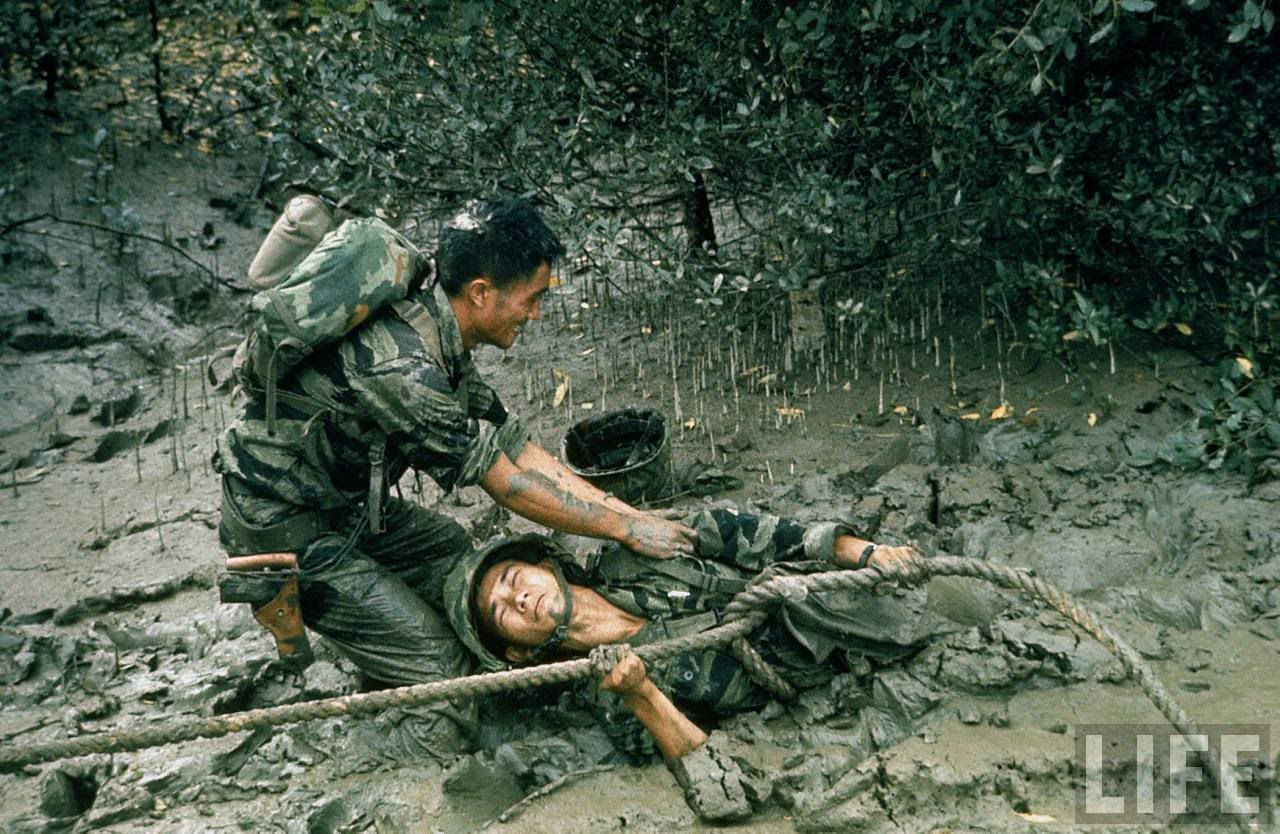 "In the Field" held a lot of images that jogged memories from my childhood- surprising I know considering the tragedy behind Kiowa's death.
The imagery used in this part of the story put me right there. I could see "the filth [that] seemed to erase identites, transforming the men into identical copies of a single soldier..." (page 156). When I read this, an image of the toy soldiers marching around Andy's room in Toy Story popped into my head, the soldiers all green and alike.
On page 158, I remembered a time at my Aunt and Uncle's lake in Michigan when I read, "Their boots sank into the ooze, which produced a powerful downward suction, and with each step they would have to pull up hard to break the hold." In the middle of my Aunt and Uncle's lake is an island. My sisters and I will kayak out to the island and walk around it. When we were little, we'd call it exploring; it was like we were the only people around! Once on our walk wading through the water around the island my sister Olivia was suddenly sucked down, the sand reaching her knees. She thought it was quick sand, but later my aunt told us that the natural springs which fill the lake make pockets for the sediment, giving it the feeling of quick sand. And this stuff smells! And it's blueish green and sticky and pulls you down. So in a way I can see the dislike of this muck-filled field! However, I can't imagine drowning in something like that as Kiowa did.
Subscribe to:
Posts (Atom)