"Shall I respect man when he contemns me? Let him live with me in the interchange of kindness, and instead of injury I would bestow every benefit upon him with tears of gratitude at his acceptance. But that cannot be; the human senses are insurmountable barriers to our union." pg 138
In the middle of the novel, Creature conveys through his story a major theme: the need of human acceptance and love. I am entranced at the deep thought and truth in this quote. Creature talks of how he has been shunned from all of society, an outcast based on prejudices. He longs for a companion or any glimpse of kindness from a human being. The hatred which shuns Creature based on his homely and frightening appearance is the barrier which Shelley deduces blocks union from the abnormal outcasts to the rest of society.
I feel like so many themes we've studied have been centered around the crucial reliance on a friend or acceptance or love of others- O'Brien searched for answers to deep questions long after the war, Phoenix Jackson attached herself to the memory of her grandson for companionship, the little old lady found pleasure in watching the scenes of the park with her little fur friend. All in all, authors have introduced us to characters whom suffer what we suffer- loss, fallout of friends, death of loved ones.
Showing posts with label theme. Show all posts
Showing posts with label theme. Show all posts
Thursday, April 21, 2011

2 Pi
"Once my fancy was soothed with dreams of virtue, of fame, and of enjoyment. Once I falsely hoped to meet with beings who pardoning my outward form, would love me for the excellent qualities which I was capable of unfolding." pg. 209
Before the slightly disturbing suicide of Frankenstein, Victor relays to Walton his main point in telling him this story. Victor imposes the goals and aspirations which he once had to delve into a place no one has been before. In doing this, utter destruction and devastation followed him around like a grey cloud. He could never escape the haunting presence of the monster he created. In telling this story, his woes, his nightmares, Victor speaks directly to R. Walton in hopes of altering his mindset. The story, in its frame story style, takes us completely full circle in understanding where and why Victor adamantly works to pry Walton from his obsession 2 Pi= full circle, eh? eh?) Walton, like Victor, wishes to discover what no human ever has. Victor Frankenstein tries desperately to defer Walton's obsession with finding a passage through the North Pole because he knows how his seemingly pointless ambitions paved the way for the most desperate life. Almost as if a last ditch attempt, he dives from the cabin window of the ship in front of Walton. If this doesn't prove to Walton his aspirations might be a little too lofty, I don't know what is!
Before the slightly disturbing suicide of Frankenstein, Victor relays to Walton his main point in telling him this story. Victor imposes the goals and aspirations which he once had to delve into a place no one has been before. In doing this, utter destruction and devastation followed him around like a grey cloud. He could never escape the haunting presence of the monster he created. In telling this story, his woes, his nightmares, Victor
 speaks directly to R. Walton in hopes of altering his mindset. The story, in its frame story style, takes us completely full circle in understanding where and why Victor adamantly works to pry Walton from his obsession 2 Pi= full circle, eh? eh?) Walton, like Victor, wishes to discover what no human ever has. Victor Frankenstein tries desperately to defer Walton's obsession with finding a passage through the North Pole because he knows how his seemingly pointless ambitions paved the way for the most desperate life. Almost as if a last ditch attempt, he dives from the cabin window of the ship in front of Walton. If this doesn't prove to Walton his aspirations might be a little too lofty, I don't know what is!
Tuesday, March 22, 2011
Excuse me! You forgot your quotes!
"I say it cause you do what I can't. What that? she say. Fight. I saw. She stand there a long time, like what I said took the wind out her jaws. She mad before, sad now." pg. 40, para. 3

I noticed off the bat that Walker strays away from quotation marks. I figured she did this for many reasons:

I noticed off the bat that Walker strays away from quotation marks. I figured she did this for many reasons:
- This book is set in simpler time, so without the quotation marks distinguishing speech from action a simplistic tone is added to the otherwise graphic novel.
- Without quotes, the reader focuses on the action and words spoken together, not separately. For instance, in the above stated quote, the thought is continuous because quotes do not separate what Celie and Sofia discuss and the feelings surrounding the text.
A bit of theme also emerges from this quote. Celie brings to Sofia's attention that the fact that she can't fight back against the beatings. Confused, I wondered how Celie could possibly prompt Harpo to beat Sofia into submission after being beaten so long herself. However, like Sofia, I was disturbed to find out that Celie envies Sofia for her ability and will to fight back. Beatings were not an anomaly for Celie, so I believe the theme of male superiority over women is especially prevalent in this scene.
Wednesday, November 17, 2010
Stay? Go? She Didn't Know!
James Joyce writes a disturbing story, "Eveline," where a problematic girl stays in her problematic world instead of venturing off with her love Frank. Eveline's childhood sounds rocky, as her father lost his temper often and came home drunk. Remarkably, her mother's last words sum up the theme of the story: "Derevaun Seraun" or "The end of pleasure is pain." What a dreadful statement yet seemingly true in Eveline's case. She finds love and happiness and acceptance in Frank; she finds excitement in the prospect of eloping with him. Yet despite her battered past, Eveline stays. She clings to the side of the boat, as if she were clinging to a world she will never know. She remains at home to fulfill her mother's dying wish for Eveline to keep the house together as long as she could. Eveline stays out of fear, like an abused woman convincing herself it is okay to leave her abusive spouse or family, only to find in the end she is kept home by some unyielding force.
Tuesday, November 2, 2010
Waiting by the Mailbox
The first thing that struck me about "How I Met My Husband" was the impending idea that Chris, the traveling pilot, would end up being young Edie's husband. Because of age and creepy encounters with Edie, I labeled Chris a bad omen for Edie in this story. Typical stereotyped man, he ends up using her and taking off! Despite all this, the story did not focus entirely around the feelings for the loss, but coping after Chris was gone. Rather positive, the end of the story conveys the theme. The theme seems blatant- sometimes we wait for nothing. "There were women just waiting and waiting by mailboxes..." describes the women waiting for a lost cause. It struck me that if we keep waiting for something better to come along or to come back then we inevitably miss out on the reality of the present. This story struck a chord: I cannot wait around for an opportunity that may never come. In order to experience, I have to reach goals by making opportunities for myself. Similarly, Edie quit her childish waiting by the mailbox and ended up obtaining something positive from it: her husband!
Wednesday, September 22, 2010
"Barbie Doll" by Marge Piercy
# 7
Naturally, this poem struck a chord for me. Piercy's theme falls along the line of society's view of beauty being absolutely warped! Here, a girl is content with herself growing up, offered the "dolls,... and miniature GE stoves and irons and wee lipsticks" presented to young girls. Society steers kids as either girlish and pink or boyish and blue. Consequently, the control society possesses on the minds of young girls is frightening. The girl in the poem is described as "intelligent" and "healthy," but that mattered little to those looking in; peers constantly judging and reshaping the person she was into the "perfect image."
Like a Barbie doll, the subject becomes plastic-like. Fake. As the poem is an overstatement, the girl didn't literally cut off her nose and legs, but it can be inferred that there was plastic surgery involved or an altering of the outward appearance. The casket reference symbolizes the dying of her inside and all she'd developed into being replaced with someone almost dead. No life can be justified from a person who has to change in order to be accepted into his/her surroundings. The upsetting part is girls and boys every where from childhood to teenage years are working to conform to the "perfect, plastic" image society wishes to see. However, my dad's always told me that it takes all people to make the world go 'round! We can't all be perfect; society would be quite boring if this were the case.
Naturally, this poem struck a chord for me. Piercy's theme falls along the line of society's view of beauty being absolutely warped! Here, a girl is content with herself growing up, offered the "dolls,... and miniature GE stoves and irons and wee lipsticks" presented to young girls. Society steers kids as either girlish and pink or boyish and blue. Consequently, the control society possesses on the minds of young girls is frightening. The girl in the poem is described as "intelligent" and "healthy," but that mattered little to those looking in; peers constantly judging and reshaping the person she was into the "perfect image."
Like a Barbie doll, the subject becomes plastic-like. Fake. As the poem is an overstatement, the girl didn't literally cut off her nose and legs, but it can be inferred that there was plastic surgery involved or an altering of the outward appearance. The casket reference symbolizes the dying of her inside and all she'd developed into being replaced with someone almost dead. No life can be justified from a person who has to change in order to be accepted into his/her surroundings. The upsetting part is girls and boys every where from childhood to teenage years are working to conform to the "perfect, plastic" image society wishes to see. However, my dad's always told me that it takes all people to make the world go 'round! We can't all be perfect; society would be quite boring if this were the case.
Friday, August 13, 2010
Storytime
I thought it random at first that O'Brien randomly brings up Linda, his childhood sweetheart. But then it hit me: maybe the book has been building up to the story of her loss. He saved his first real war experience of seeing a dead man and watching the soldiers shake hands with him for the end of the book, which ultimately led to the story of Linda.
Tim O'Brien talked about all the things the men around him carried according to job or personality. But this was what O'Brien carried: the loss of a childhood friend. He carried it all through grade school, high school, and then off to Vietnam. The death of Linda scarred him, but then again, I guess it kind of healed him. Having had "conversations" with Linda after she was dead made O'Brien respect the dead in Vietnam, however many faceless, nameless bodies he came across. He tells his readers that his worst day at war was when "for three hours [they] carried... bodies down the mountain to a clearing alongside a narrow dirt road" (page 230). Since he'd experienced the death of Linda, memories most likely surfaced due to the causalities seen in Vietnam.
Linda is also the prime reason O'Brien "had begun to practice the magic of stories. Some [he] just dreamed up. Others [he] wrote down-the scenes and dialogue" (page 231). We now see where the stories come from. As O'Brien repeats over and over that he is 43 and a writer, he admits that he is "still dreaming Linda alive...." It's like he is showing us it's okay to tell the stories over and over. To make up conversations and situations in our head. To daydream and create a world where only those we allow to be a part of can.
Stories are magic; they take us away or bring us close to our deepest regrets, greatest fears, saddest memories.
Tim O'Brien talked about all the things the men around him carried according to job or personality. But this was what O'Brien carried: the loss of a childhood friend. He carried it all through grade school, high school, and then off to Vietnam. The death of Linda scarred him, but then again, I guess it kind of healed him. Having had "conversations" with Linda after she was dead made O'Brien respect the dead in Vietnam, however many faceless, nameless bodies he came across. He tells his readers that his worst day at war was when "for three hours [they] carried... bodies down the mountain to a clearing alongside a narrow dirt road" (page 230). Since he'd experienced the death of Linda, memories most likely surfaced due to the causalities seen in Vietnam.
Linda is also the prime reason O'Brien "had begun to practice the magic of stories. Some [he] just dreamed up. Others [he] wrote down-the scenes and dialogue" (page 231). We now see where the stories come from. As O'Brien repeats over and over that he is 43 and a writer, he admits that he is "still dreaming Linda alive...." It's like he is showing us it's okay to tell the stories over and over. To make up conversations and situations in our head. To daydream and create a world where only those we allow to be a part of can.
Stories are magic; they take us away or bring us close to our deepest regrets, greatest fears, saddest memories.
Thursday, August 12, 2010
Clearing The Throat
O'Brien utilizes the chapter "Notes" to carry out a point that serves as one of the book's themes. After receiving Norman Bowker's seventeen-page note, O'Brien knew that it was his responsibility to tell the stories of so many nameless soldiers. The book serves as a catharsis- "telling stories seemed a natural, inevitable process, like clearing the throat... It was a way of grabbing people by the shirt and explaining what had happed to [O'Brien], ...all the terrible things [he] had seen and done" (page 151). But O'Brien didn't just want to share his story; he wanted to share the stories of all the men in Alpha Company and beyond in "Nam." The theme comes to life as O'Brien says on page 152 that "by telling stories, you objectify your own experience. You separate it from yourself. You pin down certain truths." Here O'Brien changes to a second-person writing style, directly speaking to the reader to get the point and purpose of all his story telling across.
I had a great-uncle who died of a heart attack about ten years ago. He faught in Vietnam, and come to find out was shot at one point during the war. I never understood his quiet nature and odd starring, but as I read this book things started to click into place. O'Brien is telling Uncle Scott's story too...
O'Brien also uses this chapter as an introduction into a chapter full of admit and guilt: "Norman Bowker was in no way responisble for what happened to Kiowa. Norman did not experience a failure of nerve that night. He did not freeze up or lose the Silver Star for valor. That part of the story is my own."
I had a great-uncle who died of a heart attack about ten years ago. He faught in Vietnam, and come to find out was shot at one point during the war. I never understood his quiet nature and odd starring, but as I read this book things started to click into place. O'Brien is telling Uncle Scott's story too...
O'Brien also uses this chapter as an introduction into a chapter full of admit and guilt: "Norman Bowker was in no way responisble for what happened to Kiowa. Norman did not experience a failure of nerve that night. He did not freeze up or lose the Silver Star for valor. That part of the story is my own."
Tuesday, August 10, 2010
theme
The annoying thing about reading books for school besides the fact that we are TOLD to do so is that we have to find all these literary words and analyze to the point of brains becoming fried. I start to tell myself we're reading way too far into the books, and there's no way the author intended for us to dissect his story like this!

Despite this, I'll always love reading. It takes me away from my world and puts me in someone else's. When I'm reading, nothing is demanded of me (until I finish a chapter and I have to take notes or be tested over it). And above all, I actually do enjoy being challenged to skim through pages with an objective in mind. I love reading and searching for the author's purpose: the theme.
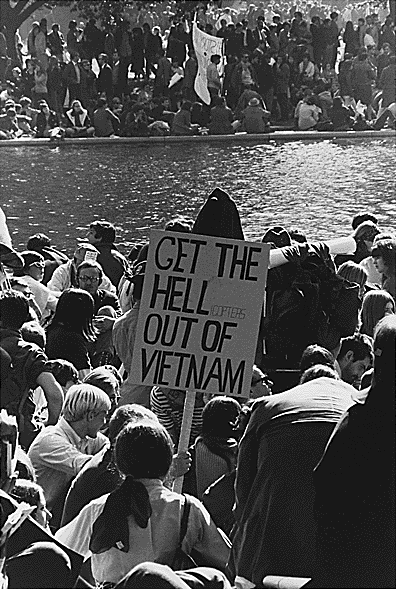
First off, O'Brien, like many Americans, seems to think that the US involvement in Vietnam was on the verge of pointlessness. On page 14 he discusses all they carry, then goes on to say "...but it was not battle, it was just the endless march, village to village, without purpose, nothing won or lost." The tone of this sentence is weary, almost as if O'Brien is tired with the way there was no purpose for the war. He felt the reasons for being in Vietnam could be taken several ways, as seen on page 15: "...and for all the ambiguities of Vietnam, all the mysteries and unknowns, there was at least the single abiding certainty that they would never be at a loss for things to carry." He comes right out and states on page 38 that "it was my view then, and still is, that you don't make war without knowing why. Knowledge, of course, is always imperfect, but it seemed to me that when a nation goes to war it must have reasonable confidence in the justice and imperative of its cause. You can't fix your mistakes. Once people are dead, you can't bring them back." O'Brien is talking about the US government's decision to go to war. He's angry with the war, still. It was a mistake. Friends lost, money lost, time lost, innocent lives lost.
Kiowa was "folded in with the war; he was part of the waste" (page 147).
Dealing with death was a theme. I particularly liked the passage on pages 169-170 that discussed all the things you can blame death on including "the war, ...the idiots who made the war, ...God, ...Karl Marx, ...or an old man in Omaha who forgot to vote." Karl Marx stands for the communistic  ideals being fought against. There are so many levels of blame in this quote from omniscient God to the little old man.
ideals being fought against. There are so many levels of blame in this quote from omniscient God to the little old man. Another theme is the beauty and sacredness of story telling. Often times an important message is tacked on to the end of chapters, like on page 36: "And sometimes remembering will lead to a story, which makes it forever. That's what stories are for. Stories are for joining the past to the future. Stories are for eternity, when memory is erased, when there is nothing to remember except." This doesn't need much explaining. For O'Brien, it's "a clearing of the throat." Storytelling will carry on forever; it's timeless.
Friday, July 9, 2010
"I'm So Paid"
"You paid some way for everything that was any good. I paid my way into enough things that I liked, so that I had a good time. Either you paid by learning about them, or by experience, or by taking chances, or by money" (pg 152). Deep! Hemingway obviously had a point to make by devoting a whole page to the concept that "the bill always [comes]" to those who have anything good. There is always some sort of expense or giving back that has to be done in return for an achievement or happy moment. Jake poses the philosophy that "maybe if you found out how to live in [the world] you learned from that what it was all about." This philosophy carries with it so many levels! First, there's the concept that by experience, one becomes wiser. Second, if we achieve through an "exchange of values" so to speak, then is there ever a point we stop making achievements? I mean, there's only so much of ourselves or our money we can give. There are those that give, and there are those that take. But here, it's plain to see that a balance between giving and taking must exist to make the exchange recognizable and worthy of happiness.
Fal$e Friend$
Bill put it best when he called Mike 'Old Mike the spender." Mike claims on page 141 that his debt came in two ways, "gradually and then suddenly." He admits to having a lot of false friends, friends that may have multiplied because of his money. Life is simple for Mike because he borrows money and eventually pays it back. In another instance, Hemingway makes a point to bring up again the 'friends' one can make due to spending money. Jake over tips to make friends, saying "[France] is the simplest country to live in. No one makes things complicated by becoming your friend for any obscure reason. If you want people to like you you have to spend a little money" (pg. 237). The dark humor here stands out like a sore thumb: Practically buying friends, like Jake does by over tipping waiters, is an obscure reason to become someone's friend!Hemingway is telling us that we can't buy friends, nor can we buy happiness. No matter how many people Jake tips or how many places he ventures too, he's never going to be really happy. His friends will be false and he has no real place to call home in the end.
Thursday, July 8, 2010
In the Beginning...
Before the story begins, Hemingway starts his readers out with some "food for thought." The epigraphs posed at the beginning provide hints at the themes and messages found throughout The Sun Also Rises. Even though Hemingway quotes one Gertrude Stein saying, "You are all a lost generation," for some reason I don't think Hemingway is bothered by this. Hemingway spent his prime years in the 1920's. In his mind, his generation wasn't lost, but rather enjoyed the constant drinking along with no set lover which led to a carefree kind of life. The next quote is from the bible, which I found particularly interesting considering the subtle dissing Hemingway seemed to resort to. It starts, "One generation passeth away, and another generation cometh..." and one gets the feel that it's just a constant cycle. No two generations are the same: take the '70's Hippie days and compare it to the proper manner of the '40's. Today's music, fashion, and sayings differs almost comically at the opposite end of what was popular 100 years ago. Hemingway poses two different questions for me despite all this: Did he use this novel to point out the things he was disappointed in? How can a generation really be lost?

"The sun also riseth, and the sun goeth down...." Hemingway seems to use this theme that the world doesn't stop. In research I've done, I find an overwhelming amount of struggles faced in Hemingways life from war to drinking problems. He seemed to choose the brighter part of the previous quote for the title of his novel, perhaps in hope that he would be able to see the up-side of things instead of the sun going down to darkness so to speak. By saying the sun ALSO rises, he's indicating that there is another side other than darkness in life.
Wednesday, July 7, 2010
Power of Prayer
With all the references to the Catholic Church, Hemingway is trying to get a point across. For the most part, he thinks some people who call themselves "Catholic" are jokes. As it is constantly discussed, dislike of the church is a common theme throughout the novel. The character Jake is one of those people who calls himself Catholic, but when it comes down to it, he can't "walk the walk." The first night in Spain, Jake finds himself in a cathedral where he begins to pray for everyone he thought of. The syntax changes during his prayer; the sentence drags on as Jake's thoughts shift from topic to topic, seemingly unable to stay in prayer. The length of the sentence enables readers to see the guilt Jake feels for his inability to pray and being "a rotten Catholic." Along with guilt, Jake is feeling sleepy, so his thoughts seem endless and random. He's shameful that he doesn't feel religious when he prays (pgs. 102-103). On page 129, Bill asks Jake if he's really Catholic, as if the answer will effect their friendship. Jake response is simple, but speaks volume: "Technically." How many people today would come up with the same answer!? I believe Hemingway is incorporating his feelings into Jake's character: although we may call ourselves Catholic, it is often difficult to live out that lifestyle in the world and customs that surround us.
Subscribe to:
Posts (Atom)