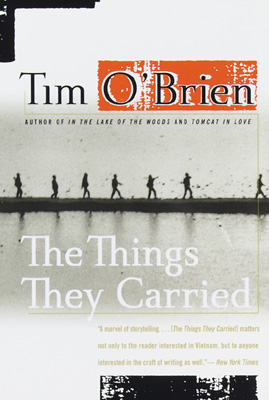
No fear- I am finished with the book The Things They Carried despite what my title may incline you to think! What I meant is the reviews! Before the story even began I was blown away by the reviews that announced the passion and connection people were able to make with this book. I'll admit that I was a little hesitant when I read one of the reviews that went like this: "...In prose that combines the sharp, unsentimental rhythms of Hemingway with gentler more lyrical descriptions, Mr. O'Brien gives the reader a shockingly visceral sense...." Nothing against Hemingway, I just found his writing style boring and distant. However, I felt like I was right there in the action while I read The Things They Carried. I could see the often "unsentimental rhythms" throughout the book, but I believe that writing style served a purpose: to initiate a feel of sarcasm amidst a serious, gruesome war story. One of the reasons Hemingway and O'Brien may have used a similar approach to telling war stories is because they actually lived it.
Tuesday, August 10, 2010
Friday, July 9, 2010
Wrapping It Up
Brett calls Jake back to where she's staying through a desperate sounding wire. Classic love yet completely abstract at the same time. Their relationship is so complicated throughout this story, but it's one of the most compelling parts of the novel. As they drove down the street on the last page, I had a flashback to the nights in Paris where they rode close together to no particular place. It made me wonder how many previous times they've been in and out of each other's lives due to Brett's jumping around. "We sat close against each other. I put my arm around her and she rested against me comfortably" (pg 251). Here we go with the "comfortable" talk: the fiesta is over so Brett goes back to her normal ways with Jake. Brett goes on to say, "'Oh Jake we could have had such a damned good time together.'" I found this almost hurtful because she's the one who's choosing not to be with him! She either means they'd have a good time married or could have had a good time during the fiesta. Either way, it's her careless nature coming into play!
I hope Jake and Brett worked out their complicated love. I hope they settled down somewhere or continued to be "expatriates" and traveled. Even after I've finished the book and understand it's FICTION, I keep wondering what became of them. I guess that's the beauty of literature: we can escape the daily confusion of our own lives and make up happy endings for someone else. (:
Tim O'Brien, here I come!
What I didn't know then
So about all the alcohol... It wasn't just in the time period that they drank a lot. It was because of all the previous happenings, especially to the men in the novel. As the story winded down, I began to realize that the consumption of alcohol was a way to free these guys minds from everything going on around them. Jake drinks because of Brett, which I think she understands since she told him not to drink and that "he'll be alright" (pg250). Also with the first world war just having ended, drinking was an escape from the horror for the veterans. Hemingway had drinking problems himself and may have strongly pronounced alcohol in the story since it was a popular escape by most in the 1920's.
So about the sexual references... Brett represents the independence of women growing about in the 1920's when the story took place. She didn't need one man to tie her down and felt no commitment to any of the men she had affairs with. Sex in the novel also brought about problems: Cohn turned from quiet to outspoken and violent when he found out Brett had been with Romero (pg 206). Jake and even Mike suffer because of Brett's infidelity and inability to maintain a permanent relationship.
Smooth Sailing
Chapter 29 is full of words indicating the resolution of the novel. It starts off, "In the morning it was all over. The fiesta was finished." Everything has died down after the bullfights. The waiters aren't in a hurry, Jake sits "comfortably" in the wicker chairs, and we are reminded yet again that the "fiesta was over." It's as if the energy and excitement that came about with the fiesta has been drained out of the city and replaced with a calm atmosphere. People are "walking" not hurrying. When Jake got out of the cab by the hotel he "rubbed the rod-case through the dust [on the car]. It seemed the last thing that connected [him] with Spain and the fiesta" (pg 236). This seems fitting; it's like the expression goes- leaving it in the dust.
Jake seems at ease when he drinks a bottle of wine for company and swims in the sea all day. One never would know the craziness of the fiesta, the injuries of the war, or the burdens on his heart the way Jake calmly strolls around. He casually drinks it away.
Belmonte
For some reason, I feel for this guy! Here he is watching Romero capture the hearts and eyes of all spectating. Belmonte came out of retirement to try and accomplish what only Romero could do. "He had meant to have a great afternoon, and instead it was an afternoon of sneers, shouted insults... Sometimes he turned to smile that toothed, long-jawed, lipless smile when he was called something particularly insulting" (pg 218). I don't think Belmonte is trying to be rude by smiling back, but merely trying to push past not only the physical pain, but also the pain of once-fans shouting out him. However, the fact that he came back and sort of played the bull-fighting system by giving tragic sensations to those in the crowd makes me frown on his lack of honesty in the sport he once was an 'aficionado' in.
To me, he symbolizes all who have tried and failed to recapture passion for something whether it be hobbies, relationships, or careers only to be overshadowed by the more interesting of the age. He could also be those who look for the glory for themselves and have a hard time sharing the limelight. "Glory fades and all we're left with are the memories made."
"I'm So Paid"
"You paid some way for everything that was any good. I paid my way into enough things that I liked, so that I had a good time. Either you paid by learning about them, or by experience, or by taking chances, or by money" (pg 152). Deep! Hemingway obviously had a point to make by devoting a whole page to the concept that "the bill always [comes]" to those who have anything good. There is always some sort of expense or giving back that has to be done in return for an achievement or happy moment. Jake poses the philosophy that "maybe if you found out how to live in [the world] you learned from that what it was all about." This philosophy carries with it so many levels! First, there's the concept that by experience, one becomes wiser. Second, if we achieve through an "exchange of values" so to speak, then is there ever a point we stop making achievements? I mean, there's only so much of ourselves or our money we can give. There are those that give, and there are those that take. But here, it's plain to see that a balance between giving and taking must exist to make the exchange recognizable and worthy of happiness.
Fal$e Friend$
Bill put it best when he called Mike 'Old Mike the spender." Mike claims on page 141 that his debt came in two ways, "gradually and then suddenly." He admits to having a lot of false friends, friends that may have multiplied because of his money. Life is simple for Mike because he borrows money and eventually pays it back. In another instance, Hemingway makes a point to bring up again the 'friends' one can make due to spending money. Jake over tips to make friends, saying "[France] is the simplest country to live in. No one makes things complicated by becoming your friend for any obscure reason. If you want people to like you you have to spend a little money" (pg. 237). The dark humor here stands out like a sore thumb: Practically buying friends, like Jake does by over tipping waiters, is an obscure reason to become someone's friend!Hemingway is telling us that we can't buy friends, nor can we buy happiness. No matter how many people Jake tips or how many places he ventures too, he's never going to be really happy. His friends will be false and he has no real place to call home in the end.
Subscribe to:
Posts (Atom)