O'Brien confused me in the chapter "How to Tell a True War Story." He contradicts himself on several occasions. By repeating the phrase "a true war story is..." we see the complexity of memories and need to share stories, however real they may be. "A true war story cannot be believed" (page 68), but then O'Brien goes on to say four pages later that "you can tell a true war story by the way it never ends." One such story is the account of how Curt Lemon died. O'Brien brings up the death four different times on pages 67, 75, 79, and 81; he can't rid his mind of this image of Lemon blowing to pieces, so he keeps bringing it up. Irony plays its part when O'Brien admits that "what wakes [him] up twenty years later is Dave Jensen singing 'Lemon Tree' as [they] threw down the pieces [of Lemon's body]." It's a war story that doesn't end.
Even though O'Brien wrote all these stories, I had a hard time believing them after reading this chapter. "It's safe to say that in a true war story nothing is ever absolutely true" (page 78); however, maybe the point isn't in the validation of the story. But in the people and the things they faced and pulled themselves through, like picking pieces of Curt Lemon out of a tree.
Wednesday, August 11, 2010

Tuesday, August 10, 2010
Back to Back
I found it interesting that O'Brien ordered the chapters "Enemies" and "Friends" back to back.
Even a title of "Enemies" couldn't bestow in my mind the absence of brotherhood between the men in O'Brien's unit, Alpha Company. While Lee Strunk and Dave Jenson got into a costly fist fight, the violence of the fight didn't cause the men to be enemies. For me, the men weren't enemies, but Jenson felt like he was in a constant battle with "skittish feelings." "The distinction between good guys and bad guys disappeared for him" (page 60) and he began behaving in bizarre ways. The enemy is the feeling of guilt and fear and restlessness.
In "Friends," it's obvious from the get-go that the pact between Dave Jenson and Lee Strunk would somehow be tested. Foreshadowing one of them getting hurt, O'Brien shares the story of how the pact was made and finally how it was tested. At the end of the chapter, we see on the surface Jensen's selfish reaction to hearing that "Strunk died somewhere over Chu Lai" (page 63), but digging deeper (as is always O'Briens purpose) we see that the weight wasn't lifted upon hearing that his friend had died and would be relieved of the war. Jensen felt relieved by knowing he didn't have to make the decision of whether or not to keep Strunk going.
I Was A Coward- I Went to the War
Courage is like an inheritance. True. We keep it locked up inside until those crucial moments where life demands more from us than we are typically used to. Aside from all this, fear is pint up inside in a similar way. It leaks out of people almost simultaneously with courage. Also true.
O'Brien wanted us to feel his guilt, his fear, his so-called cowardice. He uses what I believe is an antithesis on page 38 when saying that "certain blood was being shed for uncertain reasons;" clearly he understood there was no certainty in the Vietnam War, or any war for that matter.
I thought the gross descriptions of the pig "Declotter" job built up to the parallelism of O'Brien's paralyzing choice towards "slaughtery" if he chose to accept the draft notice on page 41. We feel his frustration with his home town as he fears being judged, so he condemns them by saying, "They didn't know history..." (page 43). By combing all of the townspeople into a common pronoun "them," O'Brien uses a synecdoche to say that the people as a group are against him.
If I can clearly recall back to sophomore year, one of the stages in the hero cycle was flight. This is exactly the approach O'Brien took when he received the draft notice, until he came across the "hero of his life," Elroy Berdahl (pages 44-45). Berdahl taught him with few words in six days that absence of fear does not make one strong, for the only conclusion O'Brien left us with at the end of the chapter was that he "would not be brave." He let embarrassment of having to face all the people in his life make the decision for him to submit himself into the war. How often are we too pressured into a route we're not too fond of due to the driving force of peer pressure. Leaving us with a paradox, O'Brien tells us of his drive home, "... and then to Vietnam, where [he] was a soldier, and then home again. [He] survived but it's not a happy ending. [He] was a coward. [He] went to war" (page 58). 'Coward' and 'war' just don't mix in my mind.
Spin
O'Brien started out the chapter "Spin" with an edge of sarcasm. He said that "war wasn't all terror and violence. Sometimes things could almost get sweet (page 30)," and then j umped immediately into a story about a kid that was "lucky" because he only get one leg shot off. The cruel reality of war shines through this dark humor. By using a simple simile by comparing war to a ping pong ball, O'Brien adds the crazy concept that war is almost treated as a game. He furthers this illusion by explaining Norman Bowker's and Henry Dobbins' nightly checkers ritual (page 31); however, he "spins" the concept by saying that with checkers there is actually visible enemy lines, knowledge of one's position, and a winner and loser, things that the Vietnam War clearly lacked.
 umped immediately into a story about a kid that was "lucky" because he only get one leg shot off. The cruel reality of war shines through this dark humor. By using a simple simile by comparing war to a ping pong ball, O'Brien adds the crazy concept that war is almost treated as a game. He furthers this illusion by explaining Norman Bowker's and Henry Dobbins' nightly checkers ritual (page 31); however, he "spins" the concept by saying that with checkers there is actually visible enemy lines, knowledge of one's position, and a winner and loser, things that the Vietnam War clearly lacked.
When O'Brien described the sense of boredom felt by those not "humping" but waiting, I could almost see the soldiers twitching with anxiety and anticipation about what would come next. Out there in the jungle with no distinct path or purpose, they must have had a lot of time to ponder the absence of loved ones, entertainment, and home. I don't get bored very easily; I try to make my own fun or take in my surroundings, but I know I'd probably go crazy living out there in a constant state of reminding myself to just relax.
O'Brien repeats several times throughout the novel that he's "forty-three years old" and "still writing war stories" (page 31 & 33). He seems to rely on this release of emotion, or catharsis, to execute his purpose for writing. He goes on to say, "the thing about remembering is that you don't forget" (page 33), speaking directly to his reader, explaining this is the only way he can tell the world.
theme
The annoying thing about reading books for school besides the fact that we are TOLD to do so is that we have to find all these literary words and analyze to the point of brains becoming fried. I start to tell myself we're reading way too far into the books, and there's no way the author intended for us to dissect his story like this!

Despite this, I'll always love reading. It takes me away from my world and puts me in someone else's. When I'm reading, nothing is demanded of me (until I finish a chapter and I have to take notes or be tested over it). And above all, I actually do enjoy being challenged to skim through pages with an objective in mind. I love reading and searching for the author's purpose: the theme.
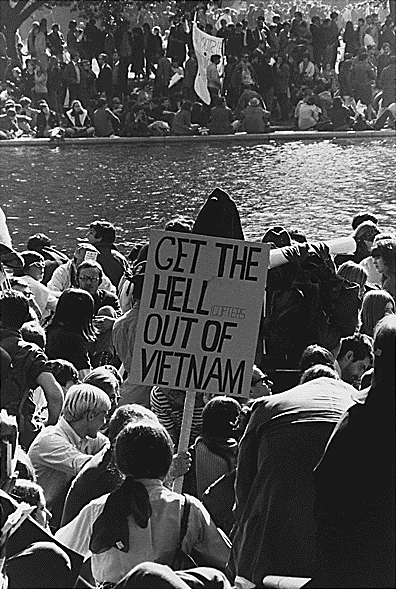
First off, O'Brien, like many Americans, seems to think that the US involvement in Vietnam was on the verge of pointlessness. On page 14 he discusses all they carry, then goes on to say "...but it was not battle, it was just the endless march, village to village, without purpose, nothing won or lost." The tone of this sentence is weary, almost as if O'Brien is tired with the way there was no purpose for the war. He felt the reasons for being in Vietnam could be taken several ways, as seen on page 15: "...and for all the ambiguities of Vietnam, all the mysteries and unknowns, there was at least the single abiding certainty that they would never be at a loss for things to carry." He comes right out and states on page 38 that "it was my view then, and still is, that you don't make war without knowing why. Knowledge, of course, is always imperfect, but it seemed to me that when a nation goes to war it must have reasonable confidence in the justice and imperative of its cause. You can't fix your mistakes. Once people are dead, you can't bring them back." O'Brien is talking about the US government's decision to go to war. He's angry with the war, still. It was a mistake. Friends lost, money lost, time lost, innocent lives lost.
Kiowa was "folded in with the war; he was part of the waste" (page 147).
Dealing with death was a theme. I particularly liked the passage on pages 169-170 that discussed all the things you can blame death on including "the war, ...the idiots who made the war, ...God, ...Karl Marx, ...or an old man in Omaha who forgot to vote." Karl Marx stands for the communistic  ideals being fought against. There are so many levels of blame in this quote from omniscient God to the little old man.
 Another theme is the beauty and sacredness of story telling. Often times an important message is tacked on to the end of chapters, like on page 36: "And sometimes remembering will lead to a story, which makes it forever. That's what stories are for. Stories are for joining the past to the future. Stories are for eternity, when memory is erased, when there is nothing to remember except." This doesn't need much explaining. For O'Brien, it's "a clearing of the throat." Storytelling will carry on forever; it's timeless.
Their War, My Memories
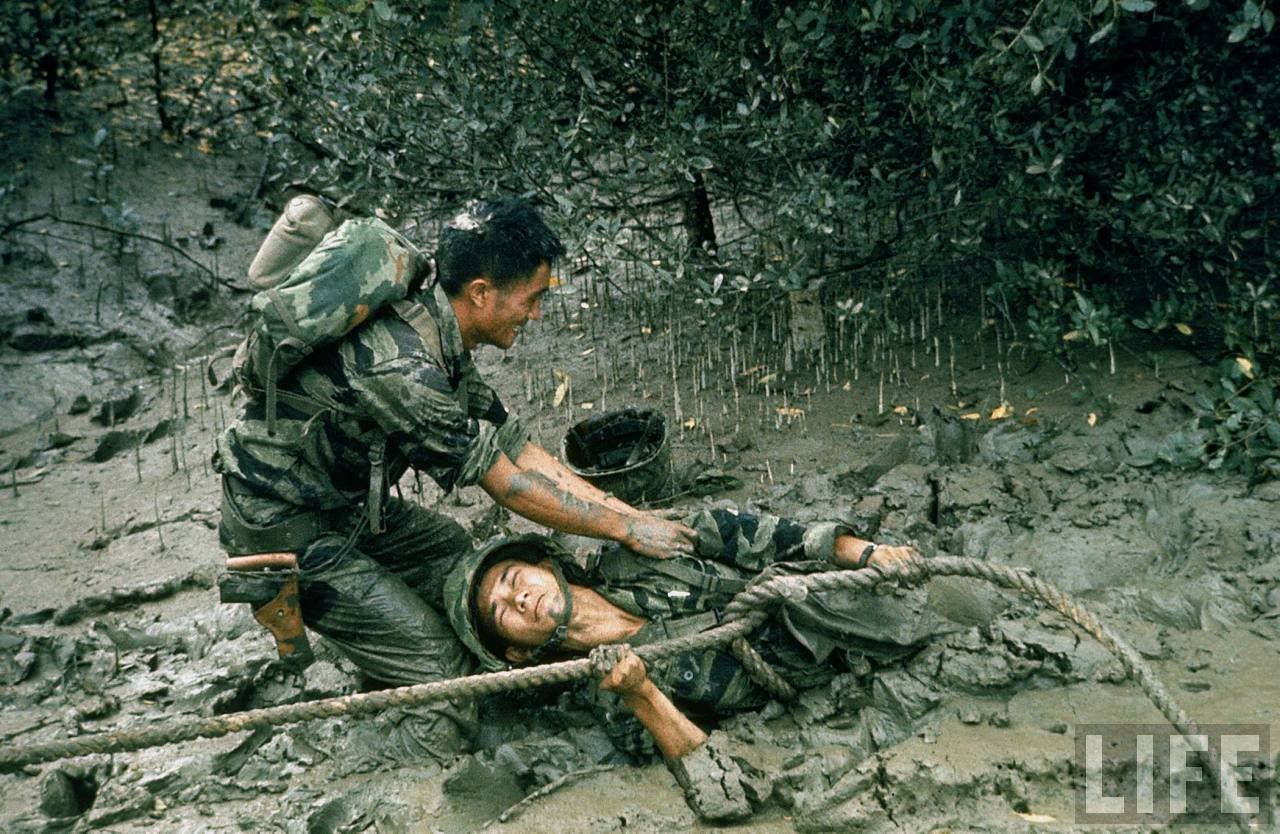 "In the Field" held a lot of images that jogged memories from my childhood- surprising I know considering the tragedy behind Kiowa's death.
The imagery used in this part of the story put me right there. I could see "the filth [that] seemed to erase identites, transforming the men into identical copies of a single soldier..." (page 156). When I read this, an image of the toy soldiers marching around Andy's room in Toy Story popped into my head, the soldiers all green and alike.
On page 158, I remembered a time at my Aunt and Uncle's lake in Michigan when I read, "Their boots sank into the ooze, which produced a powerful downward suction, and with each step they would have to pull up hard to break the hold." In the middle of my Aunt and Uncle's lake is an island. My sisters and I will kayak out to the island and walk around it. When we were little, we'd call it exploring; it was like we were the only people around! Once on our walk wading through the water around the island my sister Olivia was suddenly sucked down, the sand reaching her knees. She thought it was quick sand, but later my aunt told us that the natural springs which fill the lake make pockets for the sediment, giving it the feeling of quick sand. And this stuff smells! And it's blueish green and sticky and pulls you down. So in a way I can see the dislike of this muck-filled field! However, I can't imagine drowning in something like that as Kiowa did.
The Things They Carried

What didn't they carry through the hills in Vietnam?! O'Brien begins to develop his characters (and fellow soldiers) by directly saying what their job was in the war. The weight continued to add up. They carried "... P-38 can openers, pocket knives, ... dog tags, ... C rations, ... and two or three canteens of water" not to mention machinery and guns (page 2). The intangibles, however, is what O'Brien wanted to execute as almost unbearable: "Grief, terror, love, longing- these were intangibles, but the intangibles had their own mass and specific gravity, they had tangible weight" (page 20). O'Brien uses a juxtaposition to show the extremes at which one may be involved with war: "they carried... whatever seemed appropriate as a means of killing or staying alive (page 7). O'Brien has a way of writing memories that captures my mind, like when he says on page 7 that "they carried all they could bear, and then some, including a silent awe for the terrible power of the things they carried." I could almost feel (probably because of the weight experienced during back country on Summer Field Studies) the weight and unbelief that my body could handle all that!
I find cleverness inspiring and invigorating, partly because I'm not too quick-witted. So when I read that Lieutenant Jimmy Cross "humped his love for Martha up the hills and through the swamps," I laughed aloud. The pun meant that he carried the love through Vietnam (which inevitably cost him) and also hinted at the fact that Cross wanted a little more with Martha than just an old photograph.
Subscribe to:
Posts (Atom)